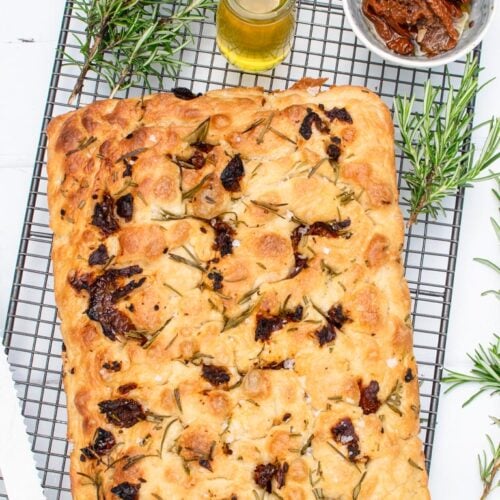
Focaccia Bread with Rosemary
This rosemary focaccia bread is wonderfully soft in the middle with a crisp, golden crust and plenty of fragrant herbs. Perfect for sharing, dipping into soups or serving alongside a relaxed lunch, it’s a simple bake that feels wonderfully rustic.
Equipment
1 oven proof dish (35x23x6cm)
1 food processor or mixing bowl
Disclaimer: the equipment list above includes affiliate links to products I use and like.
Ingredients
- 500 g strong white bread flour
- 7 g fast-action dried yeast
- 2 tsp sugar
- 1 tsp fine sea salt
- 400 ml tepid water
- 6 Tbsp extra-virgin olive oil divided, See Notes
TOPPINGS:
- 50 g sundried tomatoes finely chopped
- leaves from 3 sprigs of fresh rosemary
- flaky or coarse salt
- 1 to 2 Tbsp extra-virgin olive oil
Instructions
- Add the flour, yeast, sugar, and salt to a large mixing bowl or food processor. Keep the yeast and salt on opposite sides of the bowl before mixing (salt can inhibit the yeast if they come into direct contact). Stir the dry ingredients together.500 g strong white bread flour, 7 g fast-action dried yeast, 2 tsp sugar, 1 tsp fine sea salt
- Food processor: Fit the dough hook and set to medium-low speed. Gradually pour in the water, then add 2 tbsp of olive oil and mix until a slightly sticky dough forms. By hand: Make a well in the centre of the dry ingredients, then gradually pour in the water and 2 tbsp of olive oil. Mix with a wooden spoon or your hands until a slightly sticky dough forms.400 ml tepid water
- Knead the dough until soft and smooth: around 5 minutes with the food processor, or 10 minutes by hand on a lightly floured surface. The dough will be slightly sticky.
- Cover the bowl and leave to rest at room temperature for 10–15 minutes. With wet hands, perform the first set of stretch and folds: grab the edge of the dough, stretch it upward, and fold it into the centre. Rotate the bowl and repeat until you've worked all the way around. Cover and rest for another 10–15 minutes, then repeat for a second set.
- Shape the dough into a ball. Drizzle over 2 Tbsp of olive oil and rub it all over the dough to coat. Transfer to a large bowl if needed (the dough will roughly double in size overnight, so make sure there's plenty of room). Cover tightly with a lid, plate or cling film and refrigerate overnight.
- Brush some olive oil to grease an ovenproof dish approximately 35 x 23 x 6 cm (14 x 9 x 2½ in). (If your dish is not non-stick, swap the oil for butter or dairy-free spread so the focaccia does not stick to the dish once baked)
- With a dough scraper and/or oiled hands, gently gather the dough and transfer it to the prepared dish.
- Keeping your hands oiled, fold one side of the dough into the centre, followed by the other side over the top, just like folding a letter into thirds.
- Rotate the dough so the long edge aligns with the long side of the dish, then flip it over so the seam sits underneath and the surface is smooth. Brush the top with a little olive oil.
- Cover the dish with a baking tray, oiled on the side facing the dough.
- Leave to proof at room temperature for 2–4 hours, until the dough has puffed up and spread to fill the dish. Timing will depend on how warm your kitchen is (in winter, find a warm spot to help the process along).
- The dough is ready when it looks puffy and bubbly and wobbles when you shake the dish. It should have spread to mostly fill the ovenproof dish.
- Preheat the oven to 220°C (425°F).
- Drizzle 2 tbsp of olive oil over the surface, then press your fingers deep into the dough to create dimples all over. Scatter over sundried tomatoes, rosemary and flaky sea salt and press the toppings into the dough.50 g sundried tomatoes, leaves from 3 sprigs of fresh rosemary, flaky or coarse salt
- Bake for 25–30 minutes until golden.
- Leave the focaccia to cool in the tray for a couple of minutes, then transfer to a wire rack.
- Whilst the bread is still hot, drizzle over some more olive oil.1 to 2 Tbsp extra-virgin olive oil
- Leave to cool for 15 mins before serving.
Notes
Note 1: If your dish is not non-stick, swap the oil for butter or dairy-free spread so the focaccia does not stick to the dish once baked.
Ingredient Notes:
Strong white bread flour has a higher protein content than plain flour, which builds more gluten and gives focaccia its characteristic chewy, open texture. Plain flour will work in a pinch, but the result won't be quite as satisfying.
Fast-action dried yeast goes straight into the dry ingredients without the need need to activate it separately first. Just keep it on the opposite side of the bowl from the salt before mixing, as direct contact can "kill" the yeast.
Sugar gives the yeast a little help getting started.
Extra virgin olive oil is non-negotiable here. It flavours the dough, keeps the crumb moist, and creates the signature crispy base as it bakes. Use the best quality you can afford.
Sundried tomatoes add an intense, sweet-savoury punch.
Fresh rosemary gives a far more vibrant, fragrant result than dried.
Nutrition
Serving: 1servingCalories: 239kcalCarbohydrates: 33gProtein: 6gFat: 9gSaturated Fat: 1gPolyunsaturated Fat: 1gMonounsaturated Fat: 6gSodium: 202mgPotassium: 190mgFiber: 2gSugar: 2gVitamin A: 37IUVitamin C: 2mgCalcium: 11mgIron: 1mg